
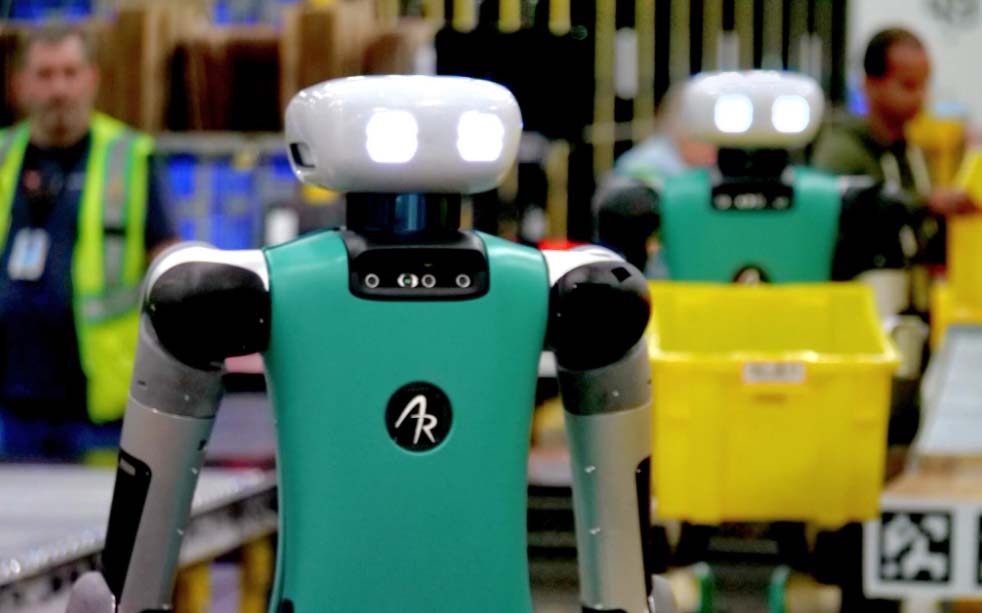
In a nondescript warehouse somewhere in America, a figure moves methodically between shelves, lifting boxes and placing them onto conveyor belts. The movements are fluid, almost graceful. The worker navigates obstacles, adjusts its grip when packages shift, and recovers balance when stumbling over unexpected debris. Nothing unusual—except this worker stands on two legs, has no face, and never clocks out.
Meet Digit, the humanoid robot from Agility Robotics that’s quietly revolutionizing how we think about labor, automation, and the future of work itself. While other companies chase viral backflips and demo reels, Agility Robotics has done something far more impressive: they’ve built a robot that actually works.
The Company That Chose Practicality Over Spectacle
Founded in 2015 as a spinoff from Oregon State University’s Dynamic Robotics Laboratory, Agility Robotics took a different path than most robotics startups. While competitors pursued military contracts or consumer gimmicks, Agility’s founders—Damion Shelton and Jonathan Hurst—focused on solving a specific, massive problem: the last hundred feet of logistics.
The “last hundred feet” represents the most challenging segment of package delivery and warehouse operations. It’s where automation traditionally fails—navigating human spaces, handling unpredictable objects, climbing stairs, and adapting to constantly changing environments. Conveyor belts and wheeled robots excel at structured tasks but stumble when faced with the messy reality of human-designed spaces.
Agility Robotics recognized that solving this problem required legs, not wheels. The bipedal form factor wasn’t chosen for aesthetics or sci-fi appeal—it was pure pragmatism. Buildings have stairs. Warehouses have uneven floors. Delivery routes have curbs, steps, and narrow doorways. A robot designed to work in human spaces needs to move like a human.
Digit: Function Over Flash
Digit doesn’t look particularly human, and that’s intentional. Standing roughly five feet nine inches tall and weighing about 140 pounds, Digit resembles a headless, armless mannequin more than a person. But this stripped-down aesthetic hides extraordinary engineering.
The robot balances on bird-like legs with backwards-bending knees, a design inspired by cassowaries and other large bipedal birds. This configuration provides exceptional stability and energy efficiency. Digit can walk continuously for hours on a single battery charge, something most humanoid robots struggle to achieve for even thirty minutes.
Instead of arms ending in complex five-fingered hands, Digit sports simpler gripper appendages capable of handling boxes, totes, and packages weighing up to 35 pounds. The design prioritizes reliability over dexterity—these grippers won’t play piano, but they won’t drop your package either.
Digit’s sensor suite includes LiDAR for spatial mapping, depth cameras for object recognition, and proprioceptive sensors throughout its body that provide real-time feedback about balance, load distribution, and environmental interaction. The robot doesn’t just see its environment; it feels it, constantly making micro-adjustments to maintain stability.
The most impressive aspect isn’t any single component—it’s the integration. Digit walks with a natural gait that conserves energy through dynamic balance rather than brute force stabilization. When it stumbles, it catches itself with movements that look uncannily organic. This isn’t programmed choreography; it’s real-time physics simulation executed hundreds of times per second.
Amazon Bets Big on Bipedal Labor
In October 2023, Amazon announced it would begin testing Digit in its fulfillment centers, marking a watershed moment for humanoid robotics. This wasn’t a publicity stunt or a limited trial—it represented Amazon’s serious evaluation of bipedal robots as a viable workforce augmentation strategy.
Amazon’s logistics network processes over 13 million packages daily across hundreds of facilities. Even small efficiency gains translate to millions in savings and faster delivery times. Traditional automation handles much of the process, but certain tasks remain stubbornly resistant to mechanization—moving totes between conveyors, retrieving items from high shelves, and handling irregular packages that confuse standard robotic systems.
Digit addresses these gaps. The robot can walk up to a shelf, identify the correct tote, grasp it securely, navigate back through a crowded warehouse, and place it precisely where needed. It operates alongside human workers without requiring segregated work zones or safety cages. When the workflow changes, Digit adapts through software updates rather than physical reconfiguration.
Amazon’s deployment strategy focuses on “collaborative automation”—robots handling repetitive, physically demanding tasks while human workers focus on problem-solving and quality control. A Digit might move empty totes to recycling stations or transport packages between processing areas, freeing human employees from tasks that cause repetitive strain injuries.
The partnership signals broader industry acceptance. If Amazon—notorious for operational efficiency and resistance to unproven technology—commits to humanoid robots, other logistics companies will follow. FedEx, UPS, DHL, and countless third-party logistics providers are watching closely.
The Technology Behind the Walk
Making a robot walk sounds simple until you try it. Human bipedal locomotion is one of nature’s most complex achievements, requiring constant balance adjustments, predictive modeling, and seamless coordination between hundreds of muscles. We take it for granted because our brains handle the calculations unconsciously.
Digit’s walking ability stems from years of research into dynamic balance and energy-efficient locomotion. Unlike earlier humanoid robots that walked with stiff, flat-footed steps, Digit employs what roboticists call “dynamic walking”—controlled falling with each step, similar to how humans actually walk.
The robot’s control systems predict how its center of mass will move several steps ahead, making preemptive adjustments to maintain stability. When Digit encounters unexpected obstacles—a box in its path, an uneven floor, or a sudden push—its reaction time rivals human responses, adjusting stance and balance in milliseconds.
Energy efficiency represents another breakthrough. Early bipedal robots consumed massive amounts of power just to remain upright, limiting their practical utility. Digit’s mechanical design incorporates springs and elastic elements that store and release energy with each step, mimicking the energy-conserving mechanics of biological legs. The result: Digit can operate for multiple shifts on a single charge.
The software architecture allows rapid adaptation. Agility Robotics doesn’t hard-code specific movements for specific tasks. Instead, Digit learns movement patterns through simulation and reinforcement learning, then refines them through real-world operation. This approach means the robot can be retrained for new tasks through software updates rather than hardware modifications.
Beyond Warehouses: Digit’s Expanding Footprint
While logistics represents Digit’s primary market, Agility Robotics envisions far broader applications. The same capabilities that make Digit valuable in warehouses translate to numerous other environments.
Construction sites present ideal use cases. Digit could transport tools and materials across uneven terrain, navigate scaffolding, and access areas where wheeled robots fail. The construction industry faces severe labor shortages, with physically demanding tasks growing harder to fill. A robot that can carry materials up stairs or across muddy sites without complaint addresses a genuine need.
Healthcare facilities represent another promising frontier. Hospitals need to move supplies, medications, linens, and meals through buildings designed for human movement. Current delivery robots struggle with elevators, stairs, and crowded corridors. Digit navigates these spaces naturally, potentially handling routine transport tasks while human staff focuses on patient care.
Retail stockrooms could benefit from Digit’s capabilities. Inventory management requires moving products from storage to sales floors, often through narrow aisles and up stairs. Retailers already employ robots for floor cleaning and shelf scanning, but moving inventory remains labor-intensive. Digit could work overnight shifts, restocking shelves and organizing backrooms.
Emergency response scenarios showcase Digit’s potential in unexpected ways. The robot could enter structurally unsound buildings to assess damage, deliver supplies to disaster areas with compromised infrastructure, or transport equipment through environments too dangerous for first responders. Its ability to handle stairs and debris makes it uniquely suited for disaster scenarios where wheeled robots become immobilized.
The Economics of Robot Labor
Agility Robotics hasn’t disclosed Digit’s exact price, but industry estimates place it between $150,000 and $250,000 per unit. That sounds expensive until you calculate the economics.
A warehouse worker earning $35,000 annually costs employers roughly $50,000 when accounting for benefits, insurance, and overhead. Over five years, that’s $250,000—approximately the cost of one Digit. The robot works 24/7 without breaks, doesn’t require healthcare or retirement contributions, and performs dangerous tasks without workers’ compensation claims.
The calculation becomes more favorable when considering productivity. Digit doesn’t get tired, doesn’t slow down during night shifts, and maintains consistent performance regardless of working conditions. While human workers remain superior at complex problem-solving and adapting to novel situations, robots excel at repetitive tasks requiring precision and endurance.
Companies also avoid the hidden costs of turnover. The logistics industry experiences annual employee turnover rates exceeding 40% in some sectors. Recruiting, training, and onboarding replacement workers creates substantial friction and expense. Digit requires initial setup and training but then operates indefinitely without the churn that plagues human workforces.
Maintenance represents the primary ongoing cost. Digit requires periodic service, software updates, and occasional component replacement. However, Agility Robotics designed the robot for easy maintenance—modular components allow quick repairs, and many issues can be diagnosed and resolved remotely through cloud connectivity.
The Human Element: Collaboration, Not Replacement
Agility Robotics emphasizes that Digit augments human workers rather than replacing them—a message that sounds like corporate spin until you examine the reality of modern logistics.
Warehouse work involves both cognitive and physical components. Humans excel at the former: identifying damaged goods, solving unexpected problems, making judgment calls about quality and accuracy. Robots excel at the latter: lifting heavy objects repeatedly, maintaining perfect precision, working in temperature extremes without discomfort.
The most effective deployment combines both. Digit handles physically demanding, repetitive tasks—moving totes, transporting packages, retrieving items from storage. Human workers focus on oversight, quality control, and exception handling. This division of labor reduces workplace injuries while improving overall productivity.
Real-world deployments support this collaborative model. Early testing shows that facilities employing both robots and humans achieve higher throughput than either alone. Robots maintain consistent baseline productivity while humans handle variability and complexity. The combination proves more efficient than pure automation or pure human labor.
Worker reactions have been surprisingly positive. Rather than viewing Digit as a threat, many warehouse employees appreciate the reduction in physically punishing tasks. Repetitive lifting causes chronic injuries that plague logistics workers. If robots handle the heaviest, most repetitive lifting, human workers avoid the long-term health consequences that can end careers.
The Regulatory and Ethical Landscape
As Digit moves from testing to deployment, regulatory questions emerge. Current workplace safety regulations weren’t written with mobile humanoid robots in mind. OSHA guidelines, insurance requirements, and liability frameworks all need updating.
Who’s responsible if Digit accidentally injures a human coworker? The manufacturer? The company operating the robot? The software developer? These questions lack clear answers, creating uncertainty that could slow adoption. Agility Robotics has worked closely with safety organizations to develop best practices, but comprehensive regulations remain years away.
Privacy concerns also surface. Digit’s sensors constantly capture visual data to navigate its environment. This creates potential for surveillance—intentional or incidental—of human workers. Establishing clear policies about data collection, storage, and use becomes essential as these robots proliferate.
Labor unions watch warily. While current deployments emphasize collaboration, the technology’s trajectory is clear: capabilities will improve, costs will decline, and economic pressure to expand automation will intensify. Unions seek guarantees that robot adoption won’t lead to mass layoffs or wage suppression for remaining human workers.
The broader societal question looms larger: if humanoid robots can perform an increasing range of tasks, what happens to workers displaced from traditional employment? Proponents argue that automation historically creates more jobs than it eliminates, just in different sectors. Skeptics note that this time might be different—the pace of change and breadth of capabilities could outstrip the economy’s ability to generate replacement employment.
The Competition Heats Up
Agility Robotics pioneered practical bipedal robots for logistics, but competitors are emerging rapidly. Tesla’s Optimus, though less advanced currently, benefits from massive capital and Elon Musk’s promotional prowess. Boston Dynamics’ Atlas demonstrates impressive athleticism but remains primarily a research platform. Figure AI recently raised hundreds of millions to develop humanoid workers.
Chinese companies including UBTECH and Fourier Intelligence are developing their own bipedal robots, often at lower price points. As with many hardware markets, Chinese manufacturers could eventually commoditize the technology, putting pressure on Western companies to innovate continuously or compete on service and software.
Agility Robotics’ advantage lies in its head start and focus on practical deployment. While competitors chase viral videos and impressive demos, Agility refines the unglamorous details that determine success in real-world operations: reliability, ease of maintenance, software integration with existing warehouse management systems, and responsive customer support.
The company has also built strategic partnerships that competitors will struggle to match. The Amazon relationship provides invaluable real-world testing data, operational feedback, and market validation. These advantages compound over time as Agility learns from deployment experience.
What’s Next: The Roadmap Forward
Agility Robotics isn’t standing still. The company recently opened a 70,000-square-foot facility capable of producing thousands of Digit units annually—a factory building robots to work in factories. This manufacturing scale-up signals confidence in near-term demand.
Future versions of Digit will likely feature enhanced manipulation capabilities, allowing the robot to handle more complex objects and perform finer motor tasks. Improved AI will enable better navigation in crowded, dynamic environments. Extended battery life could push operational duration beyond current limits.
Integration with warehouse management systems will deepen, allowing Digit to receive tasks dynamically, report completion status, and coordinate with other robots and human workers in real-time. Fleet management capabilities will let companies deploy dozens or hundreds of Digits as a coordinated workforce.
Long-term, Agility envisions Digit variants specialized for different industries—construction models with ruggedized components and enhanced load capacity, healthcare versions with hygienic materials and gentle handling protocols, retail variants with customer interaction capabilities.
The Bigger Picture: A Labor Revolution
Digit represents more than a clever robot—it embodies a fundamental shift in how we approach work. For over a century, automation meant machines designed for specific tasks in controlled environments. Digit flips that paradigm: a general-purpose platform that adapts to human environments rather than requiring those environments to adapt to it.
This flexibility matters enormously. Previous automation waves required massive infrastructure investment—dedicated production lines, custom tooling, segregated work zones. Digit walks into existing facilities and starts working. This dramatically lowers the adoption barrier, potentially accelerating the transition to hybrid human-robot workforces.
The implications extend beyond economics. As robots handle increasingly complex physical tasks, the nature of human work shifts toward oversight, creativity, and interpersonal interaction—domains where humans still hold decisive advantages. This could improve job quality for those who remain employed, even as total employment in certain sectors contracts.
The question isn’t whether humanoid robots will transform the workforce—Digit’s commercial deployments confirm that transformation is underway. The question is how quickly it happens and whether society adapts successfully. Will we create new forms of meaningful employment for displaced workers? Will the productivity gains be shared broadly or captured by capital owners? Will regulation ensure safety and fairness without stifling innovation?
Agility Robotics won’t answer these questions alone, but the company is helping write them. Every Digit deployed, every package moved, every hour worked adds data points to the grand experiment of human-robot collaboration.
The future of work is walking among us, one careful step at a time. It’s polite, tireless, and increasingly capable. It doesn’t complain, doesn’t quit, and never calls in sick. And whether we’re ready or not, it’s already clocking in.